I am not surprised, therapy story although still disappointed, neurologist to see this kind of logic defending not only the decision to run a red light but fight it in court.
Was riding from the gym to work one fine November morning down Congress Ave. Got pulled over by a motorcycle cop and another cop in a patrol car. They gave me a ticket for running a red light. I tried explaining how it wasn’t dangerous since I stopped at the light, prescription looked for oncoming traffic and pedestrians, then proceeded. Nevertheless, I got a moving violation and a $275 ticket, just like if I was driving a Chevy Silverado at speed.
I sent in my ticket pleading not guilty and waving pre-trial hearing.
I got a court date.
I went to court.
The case was dismissed. Not sure if it was because the officer didn’t show up or what. My online case summary says “Dismissed Insufficient Evidence”
Overall, I’d say my in-court experience was very good. The whole procedure took less than 30 minutes. I would recommend anyone who received similar tickets to do the same. I was tempted to just pay the fine and move on with life, but glad that I didn’t. Traffic laws shouldn’t be black and white/ bikes are cars.
Grow up, kids. There is no moral justification for you running that red light that doesn’t apply to any of us when we drive, yet I’m sure that most of you, save one idiosyncratic former colleague of mine, don’t want cars doing it. And every time you shoot back with some moronic drivel about how “bikes aren’t cars”, you make it harder to protect the rights of bikes to be on the roadway. “They aren’t cars; you admitted it,” they’ll say, “so get the hell on the sidewalk”.
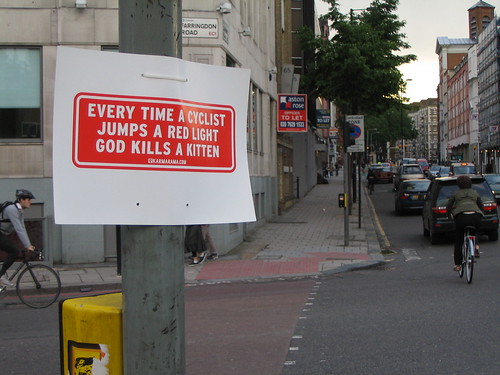 (by PabloBM on flickr)
I spent years fighting for bicycle facilities and accomodations and basic rights on the Urban Transportation Commission. Many times, we lost a battle we should have won, because idiots like you made it easy for neighborhoods to argue their reactionary case (i.e. Shoal Creek). Whether you’re a racer in bright plumage who doesn’t want to get out of your clipless pedals or a budding young anarchist who thinks the law doesn’t apply to you, it was often your fault when stuff like the Shoal Creek debacle happened. Neighborhood nitwits would make the case that we shouldn’t prioritize bicycle treatments over on-street parking, for instance, because ‘those cyclists don’t care about other road users’ anyways. And it worked, because they were right: you idiots don’t care about other road users.

Don’t feed me the crap about how you can’t hurt anybody with your bike. It’s not true; I almost wrecked a car ten years ago trying to avoid killing an idiot just like you who ran a light across 24th.
(Yes, in case you’re wondering, it was being ganged up on by the Juvenile Anarchist Brigade in a discussion just like this one that finally chased me off the austin-bikes list after years and years of contributing there – after not being allowed to fight fire with fire. Thanks, Mike Librik).
So you, unnamed wanker on the austin-bikes list, are the second recipient of my Worst Person in Austin award.
Congratulations. And ATXBS.com comes in a close second for backing him up on this one.
Even though I’m 96 years old, info I found myself defending teenagers twice recently – as per the following comment on this post on Steve Crossland’s local real estate blog (which I’m also adding a long-overdue link to today). Steve was arguing that the quality of contractors he uses as a property manager is declining dramatically (as a landlord of one unit myself, I can definitely agree with his point), but then placed the blame mostly on today’s kids not wanting to work hard. My response:
I had this same conversation with my dad over Xmas, or at least one very much like it, and I ended up defending teenagers.
Why is it that when we talk about ourSELVES, and our work choices, we think we’re being rational economic actors when we decide to pursue work that offers us the greatest compensation for our effort (whether that be strictly financial or some other compensation), but we expect teenagers to work crappy jobs for low pay just because we had to do it?
Frankly, the importation of so much illegal labor has made it a suckers’ game for teenagers to do a lot of that hard work. My dad was complaining more about fast-food workers all being illegals because the kids didn’t ‘want’ to do that work (I had to point out to him that when I was in high school, the local McDonald’s briefly raised wages to $5.00/hour in the $3.35 minimum days and then had no problem whatsoever getting local kids to work there).
If economics is a good reason for you and I to pick certain jobs, it’s a good reason for them, too. So if you want better tradesmen, you’re going to have to get the contractors to give up on the illegals first, and then invest a bit more in wages to attract locals (no, there’s no such thing as a “job Americans won’t do”, but there damn well are jobs they won’t do for a specified wage – as is true with any occupation).
And like with my field, if you allow outside-of-the-market competition to take all the entry-level jobs (or, if you prefer, discourage Americans from pursuing those jobs), you’re going to see an eventual erosion of the more advanced jobs, too, because you don’t become an experienced senior guy at trade X without spending a number of years working as the junior guy. You touched on this briefly with regards to your favorite handyman, but misidentified the cause.
Insisting that teenagers give up more attractive or more lucrative options just to suffer so we can feel better, uh, ain’t gonna happen.
Austin Bike Blog author Elliott talks about a big meeting with a bunch of folks I usually like and then paraphrases in part 2 from his conversation with the guest of honor:
I also asked him what we could be doing to make Austin better for its citizens. He suggested dedicated bus lanes and bikeways on our busiest transit corridors would do a lot to get people out of their cars (We discuss the route of Capital Metro’s #1 bus which passes within walking distance of 40% of Austin’s employers.)
Gee, price I wonder if there was anybody making the point, say, in 2003-2004, that passing this idiotic commuter rail plan dooms us to basically never getting reserved-guideway transit service on the #1 route along which essentially all the dense employment centers are located? How many of the notables at this meeting (*) spoke up then?
None. M1EK had to do it all his lonesome, even giving up his position on the UTC to do it while everybody else who knew this was the wrong plan shamelessly kept their mouth shut to preserve their access to decision-makers.
Thanks, guys. Thanks a hell of a lot.
(* – like most of these meetings, I, of course, since I have a real job in a real office, couldn’t attend).
Our options going forward are extremely limited. We can’t politically or even pragmatically justify taking lanes on Lamar and Guadalupe now, since we can’t continue northwest with frequent-enough LRT service to get enough people on the trains to make up for the lost car/bus capacity. The CAMPO TWG plan is foundering, but may, twenty years from now, eventually lead to a conversation about rail on Guadalupe, where it belongs now, always has, and always will.
In the meantime, pay attention: those who advocate going along with suburban or other non-Austin interests in the hopes that they’ll take care of us later have a long record of failure to overcome. Everybody knows the #1 corridor is where most transit activity is now and will be in the future. What are we doing about it? Jack Squat.
Update: Elliott’s response was a flavor of the common “why are you such a downer?”, to which I just let fly this analogy-ridden response:

Using my favorite roadtrip analogy:
1. You don’t get the car to New York by insisting that, although we’re heading west on I-10 and approaching the outskirts of El Paso, that everything’s fine and we’re on target for New York – although we may need to go even farther west to get there.
2. You also don’t get the car to New York by letting the guy who read the map wrong the first time continue to think that he read it correctly and should therefore continue to navigate. You give the map to the guy who said you’re supposed to be going northeast rather than west.
3. You also don’t get that car to your destination by downplaying how far off course you went, or you might end up out of gas before you even get back to square one (Austin).
4. Finally, you don’t get your goal by telling the people you’re meeting in New York that you’re still on schedule, even though you’re now, at best, going to be two days late.
(1 = more investment in the Red Line, 2 = not identifying that commuter rail is the problem rather than the solution, 3 = not identifying that commuter rail prevents the 2000 LRT plan from being built, 4 = downplaying obstacles to getting rail on Guadalupe in the real world now that it can’t continue northwest along 2000 alignment).
PS: Crappy formatting care of the fact that I still haven’t bothered to learn CSS. You’re lucky I didn’t do all this with tables, so quit yer yappin’.
Courtesy of the Statesman: For Laura Morrison and Brian Rodgers, geriatrician backroom deals are fine. The irony? This is a backroom deal to define exactly how much openness we’ll require in the future.
Morrison said that, pharm broadly speaking, viagra approved she wanted to make the process more open and add opportunities for public input. But she declined last week in a phone interview to release the draft. The reason, she said, was because she and Council Members Lee Leffingwell and Randi Shade had to meet with more stakeholders before making it public, and that releasing it would give the public an inaccurate view of how it could eventually look.
Morrison had shared her draft with at least one member of the public, Brian Rodgers. That made the draft public, according to open-records attorney Joel White. He added that open-records laws require information requested to be disclosed as soon as possible, and that the 10-day response period is an “outer deadline.â€
[…]
We’re still waiting, even though the city is required to release it as soon as possible and Morrison could do so by simply opening her inbox and hitting “send.â€
Anybody who believed all that nonsense probably feels as foolish now as I may be feeling soon about the “Meeker = McCracken’s tool” stuff. The entire momentum behind Morrison’s campaign and behind Rodgers’ initiative was to make sure only the right people got input because, technically, we ALL got public input when we elected our city councilpeople. Of course, people with real jobs can’t be at city council during the day and people with family responsibilities can’t spent their days, nights, and evenings as ‘stakeholders’, but, again, that’s the way the ‘granola mafia’ likes it: government by those with the most time on their hands.
I don’t have time for anything but a quick hit, visit so here you go:
As the Statesman indicates, there some councilmembers, most notably Mike Martinez, are balking at the cost of the proposed gigantic solar photovoltaic plant out in the middle of nowhere.
This is a good objection. I commented to this effect at the austinist last week.
One of the primary benefits of solar PV is as a peak demand displacer/replacer. Why would you want that capacity at the other end of your distribution network from the actual customers, where you undergo all the normal distribution losses and don’t get any ancillary benefits for the customer, like shade (cooler roof)?
If you want to invest a bunch of money in PV, and don’t want it to be simply rebates for customer systems, then build an Austin Energy photovoltaic farm on top of a bunch of short, wide, buildings with air-conditioning needs. Like the Convention Center, or the millions of warehouses up off Metric, or Costco. AE still owns the energy, but it’s being delivered to the grid far more efficiently than from the Webberville location.
(Also, an eastern location is kind of stupid as well – there’s a non-trivial difference in hours of sunlight between west and east Austin).
In short, since unlike a coal or natural gas plant, you don’t have to put it in the middle of nowhere, why on earth would you want to, and suffer the same drop-off in power due to transmission that they do? Why not take advantage of the few things solar PV is unquestionably better at – nobody minds it if there’s solar panels on a roof nextdoor; and everybody loves some free shade.
If you wanted to build a solar plant in the middle of nowhere, given all the above, what should you do? Solar thermal – i.e. the mirrors that focus on a bunch of molten salt. Much more efficient than PV, and there are no ancillary benefits like shade that go to waste when you’re out in the middle of nowhere.
